
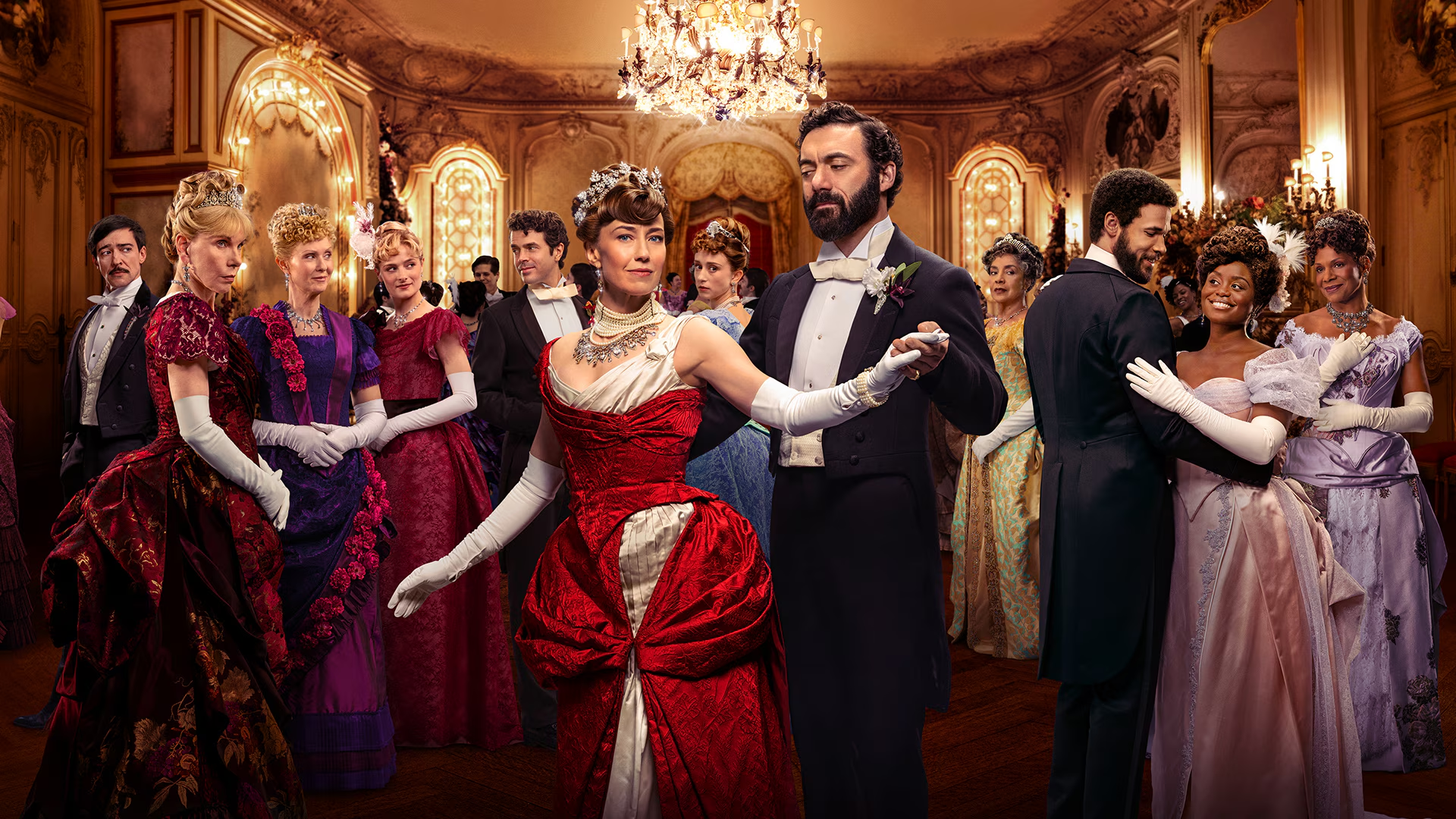
The season explores how families like the Vanderbilts transformed from working-class roots into American royalty within a single generation, using railroad monopolies, stock manipulation, and social engineering that would make modern billionaires look like amateurs. Cornelius Vanderbilt famously started as a Staten Island ferry operator and died worth $100 million—equivalent to $2.3 billion today.
But the real drama happened in the drawing rooms, not boardrooms. These families weaponized society events, strategic marriages, and cultural institutions to legitimize fortunes built through methods that bordered on criminal. The show’s portrayal of Bertha Russell seeking English aristocratic connections mirrors real-life American heiresses who were literally auctioned off to bankrupt European nobles.
The most shocking truth? These “American aristocrats” were often more ruthless than their European counterparts, combining Old World social climbing with New World industrial brutality to create unprecedented concentrations of wealth and power that reshaped American society forever.
Season 3’s focus on divorce, death, and violence isn’t dramatic exaggeration—it’s historical accuracy. The Gilded Age elite destroyed competitors, manipulated markets, and orchestrated social destruction with the same precision they applied to building railroad empires and steel monopolies.
The Vanderbilt Money Machine: From Ferry Boats to European Castles
Cornelius Vanderbilt’s transformation from a $100 loan in 1810 to controlling America’s railroad system reveals the blueprint every Gilded Age fortune followed: identify transportation chokepoints, eliminate competition through any means necessary, then use monopoly profits to buy social legitimacy.
The family’s railroad empire generated cash flows so massive they could afford to lose millions on social climbing projects. Alva Vanderbilt spent $3 million (equivalent to $75 million today) on a single costume ball in 1883—money earned from charging farmers extortionate rates to ship grain to market.
Here’s where it gets ruthless: When competitors challenged Vanderbilt’s monopolies, he didn’t just undercut prices—he bought judges, bribed legislators, and orchestrated stock market crashes that bankrupted entire regions. The phrase “robber baron” wasn’t metaphorical; these men literally robbed the American economy through legalized theft.
The European aristocracy connection served strategic purposes beyond social validation. By marrying daughters to cash-poor European nobles, American families gained access to international banking networks, diplomatic immunity, and cultural legitimacy that protected their fortunes from democratic interference.
The Consuelo Vanderbilt scandal HBO explores in Season 3 exposes the darkest family secret: her mother Alva literally imprisoned her daughter for months, threatening suicide and disownment, to force marriage to the Duke of Marlborough. The $2.5 million dowry (equivalent to $76 million today) bought the family a duchess title—and Consuelo a lifetime of misery.
The Marriage Market: How American Heiresses Became European Currency
Between 1870 and 1914, over 500 American heiresses married European aristocrats in what historians call “the great exchange”—American money for European titles. The total dowries exceeded $220 million (roughly $6.7 billion today), making it the largest international wealth transfer in history.
These weren’t romantic unions but calculated business transactions. European nobles faced bankruptcy from agricultural decline and changing economies, while American families needed social legitimacy their new money couldn’t buy domestically. The marriages were literally negotiated like corporate mergers, with lawyers drafting contracts that specified everything from inheritance rights to social obligations.
The tragedy? Many American heiresses were essentially sold into loveless marriages with abusive or indifferent husbands who viewed them as walking ATMs. Consuelo Vanderbilt’s marriage to the Duke of Marlborough was so miserable that she eventually divorced—scandalous for the era—and wrote memoirs exposing the entire system.
The Astor Landlord Empire: How Rent Collection Built a Dynasty
While Vanderbilt dominated transportation, the Astor family perfected an even more sinister wealth strategy: land monopolization in Manhattan. John Jacob Astor bought massive tracts of undeveloped Manhattan real estate in the early 1800s, then sat back and collected rent as the city grew around his properties.
The Astor strategy was diabolically simple: buy land cheap, hold it until scarcity drives up values, then charge whatever the market will bear. By the Gilded Age, the family owned most of Manhattan below 59th Street, generating rental income that required zero innovation, zero risk, and zero social value—pure wealth extraction.
Here’s the twisted part: as Manhattan became more valuable, the Astors actively prevented development that might benefit tenants or reduce their control. They kept properties deliberately underdeveloped to maintain artificial scarcity, forcing New Yorkers to pay premium rents for substandard housing.
The family’s social climbing strategy differed from the Vanderbilts: instead of buying European titles, they positioned themselves as America’s “original” aristocracy, claiming their early Manhattan ownership made them more legitimate than newer industrial fortunes. This required elaborate historical mythology that portrayed land speculation as aristocratic tradition.
The Darkest Astor Secret
During the 1863 Draft Riots, the family hired private security to protect their properties while refusing to house refugees or provide aid to the working-class neighborhoods that made their wealth possible. They literally profited from social chaos while contributing nothing to its resolution.
Carnegie’s Steel Monopoly: Philanthropy as Public Relations
Andrew Carnegie perfected the most sophisticated wealth-to-legitimacy conversion strategy: strategic philanthropy that rebranded industrial brutality as social virtue. His steel empire generated profits through worker exploitation, environmental destruction, and monopolistic practices, then used a fraction of those profits for libraries and universities.
The Carnegie formula was brilliantly manipulative: work employees 12-hour shifts in dangerous conditions, suppress unions through violence, eliminate competitors through predatory pricing, then donate money for public buildings that carried his name forever. He bought historical immortality while maintaining systems that crushed the very people who would use his libraries.
The Homestead Strike of 1892 reveals Carnegie’s true character: while publicly advocating for worker rights, he authorized private security forces to kill striking steelworkers demanding basic safety protections. The massacre killed nine workers, but Carnegie’s philanthropy successfully whitewashed the bloodshed from historical memory.
The Social Warfare: Mrs. Astor’s Ballroom and the 400
Caroline Astor’s “Four Hundred” list—the definitive registry of New York society—represented the most exclusive membership organization in American history. Her ballroom held exactly 400 people, and invitations determined who counted as American aristocracy regardless of wealth or achievement.
The list served as social control mechanism that forced even the wealthiest families to seek Astor approval for legitimacy. Families worth hundreds of millions were excluded if they lacked proper social connections, while relatively modest fortunes gained enormous influence through Astor endorsement.
The system created artificial scarcity around social status that mirrors modern influencer culture: access to exclusive events became more valuable than money itself, forcing wealthy families to compete for Mrs. Astor’s attention through increasingly elaborate displays of cultural sophistication and social conformity.
The Ultimate Irony
Mrs. Astor’s own family wealth came from rent collection and land speculation—yet she positioned herself as guardian of “refined” society while excluding entrepreneurs and inventors whose innovations actually improved American life.
The Newport Playground: Conspicuous Consumption as Competitive Sport
Newport’s “summer cottages”—mansions with 50+ rooms for three-month seasonal use—represented the most extreme wealth display in American history. Families spent more on single-season entertaining than most Americans earned in lifetimes, turning vacation homes into monuments to financial excess.
The Breakers, Cornelius Vanderbilt II’s Newport mansion, cost $7 million to build (equivalent to $213 million today) and required 50 full-time servants for a family of six. The dining room could seat 34 guests for meals that featured ingredients shipped from Europe and prepared by internationally recruited chefs.
These weren’t homes but stage sets for social performance that demonstrated wealth so extreme it transcended practical utility. Families competed through architectural excess, entertaining costs, and staff size that served no purpose beyond proving they could waste money on scales that dwarfed entire city budgets.
The Crash and Burn: How American Aristocracy Destroyed Itself
The supreme irony of Gilded Age wealth? Most families lost their fortunes within two generations through the same social climbing that created their status. European aristocrats, professional fortune hunters, and social parasites systematically drained American wealth through marriages, investments, and lifestyle inflation that exceeded even robber baron earning capacity.
Consuelo Vanderbilt’s story epitomizes the tragedy: forced into European marriage that transferred millions overseas while providing no personal happiness or family benefit. Her divorce in 1921 revealed that American heiresses were often financial victims of the very social systems their families created.
The final collapse came during the Great Depression, when overleveraged fortunes and European investments evaporated overnight. Families that once owned Manhattan blocks ended up selling mansions for fractions of their construction costs, proving that artificial aristocracy couldn’t survive economic reality.
The Lasting Legacy
These families did successfully transform American culture by establishing precedents for extreme inequality, conspicuous consumption, and social exclusion that persist today through different mechanisms but identical underlying dynamics.
HBO’s The Gilded Age Season 3 captures this historical moment when America’s democratic ideals collided with aristocratic ambitions, creating social tensions and wealth concentrations that continue shaping American society 150 years later through evolved but recognizable patterns of power, privilege, and social climbing.