

Worldwide — Microsoft Outlook experienced a significant global outage on July 10, 2025, leaving millions of users unable to access their mailboxes across various platforms, including web, mobile, and desktop applications. The outage stretched past 11 hours, affecting millions of users worldwide and marked one of the most severe disruptions to the email service in recent years.
The disruption began around 10:20 PM UTC on July 9, 2025, and persisted into the following day. Users attempting to access Outlook encountered a “Something went wrong” error message, preventing them from retrieving emails, managing calendars, or accessing contacts.
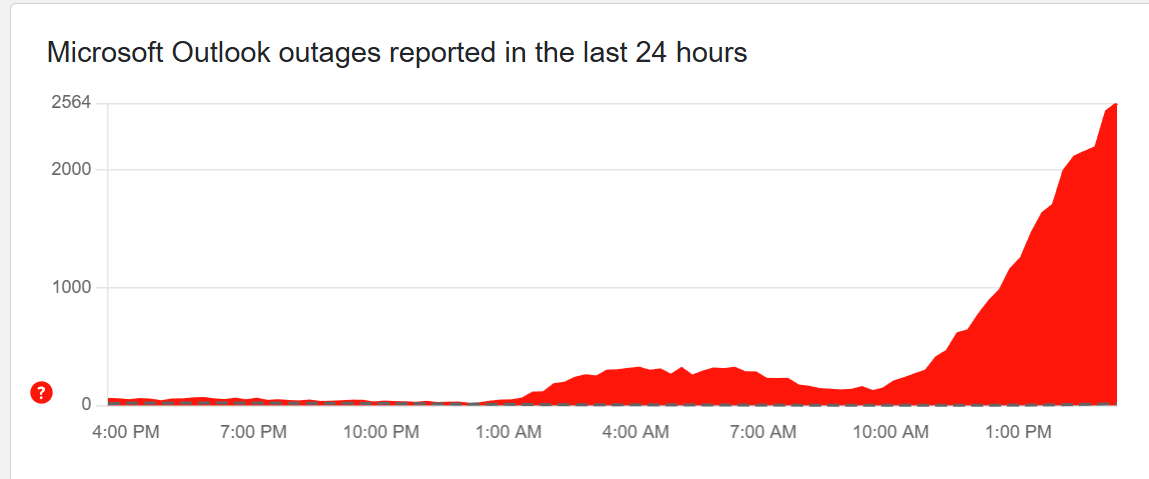
Scale of the Disruption
At the peak of the outage, monitoring platforms like DownDetector recorded over 2,800 reports at 11:45 AM ET. According to Down Detector, 61% of users reported login issues while 34% had server connection problems. Multiple independent monitoring sites recorded hundreds of thousands of complaints within the first hour of the outage.
Social media trends placed “Outlook Down” among the top 10 topics globally within two hours, suggesting the severity and scale of the disruption extended to Microsoft’s full global user base, estimated to be in the hundreds of millions. Outlook has a user base of nearly 400 million users globally , making this one of the most widespread service disruptions of 2025.
The outage was not limited to a specific region; reports indicated that users in multiple countries, including the United States, United Kingdom, Australia, and Canada, were affected. Cities such as São Paulo, New York, London, and Berlin recorded complaints, highlighting the scale of the problem.
What Caused the Outage
Microsoft’s service status page confirmed that “users may be unable to access their mailbox using any connection methods,” including Outlook.com, Outlook Mobile, and the Outlook desktop client. Microsoft stated that “a portion of mailbox infrastructure isn’t performing as efficiently as expected” and suspected the glitch was related to an authentication component.
The instability was centered on authentication failures, exposing the global reliance on cloud-based email tools. Some users received messages stating they no longer held a valid license to access the service , despite having active, paid subscriptions.
This incident marks the latest in a series of outages affecting Microsoft’s email services over the past year. In March 2025, Microsoft Outlook experienced a significant global outage due to a buggy update, and in May 2025, another outage occurred due to faulty code deployment.
Microsoft’s Most Popular Programs Affected
The outage impacted several core Microsoft services that millions rely on daily. Microsoft 365 encompasses core applications such as Outlook, Word, Excel, PowerPoint, OneDrive, SharePoint, OneNote, and Teams. Microsoft 365 has nearly 345 million paid subscribers and an estimated 321 million active users.
Microsoft reported that Office 365 now has more than 400 million paid seats, making it one of the world’s largest productivity platforms. Microsoft’s cloud computing service Azure generated $80 billion in revenue, followed by Microsoft 365 earning $49 billion in recent fiscal reports.
More than 3.7 million companies worldwide rely on Microsoft Office 365 for productivity. The construction industry has the highest adoption at 6%, followed by IT and retail at 4% each, with healthcare and finance following at 3% each.
Business Impact
The inability to access Outlook services had significant implications for both individual users and businesses. Professionals relying on Outlook for business correspondence, scheduling, and collaboration faced delays and interruptions. Professionals reported difficulties accessing event tickets, confirming meetings, or responding to urgent emails.
In Microsoft 365 apps, users spend 60% of their time on emails, chats, and meetings, and only 40% in creation apps like Word and PowerPoint. This heavy reliance on communication tools made the outage particularly disruptive for businesses worldwide.
According to a survey, Microsoft Office 365 is used by four out of every five Fortune 500 companies, meaning the outage likely affected major corporations across all industries. The US leads with 34% of Microsoft Office 365 customers, followed by the UK with 8%.
Microsoft’s Response
Microsoft acknowledged the issue through its official Microsoft 365 Status handle on X (formerly Twitter), stating that they were investigating the problem and working on deploying a fix. Microsoft announced that a fix was being rolled out globally, but without providing a definitive timeline for resolution.
Microsoft 365 acknowledged the problem on X: “We’re currently investigating an issue.” Later: “We’ve determined the cause and have deployed a fix. We’re closely monitoring its deployment”. However, the Microsoft Service Status Checker continued to show ongoing disruptions for Outlook, with users still unable to access their mailboxes via any connection method.
Microsoft reported that the fix was progressing quicker than anticipated and expected the issue to gradually resolve as the deployment progressed. This outage extended beyond 11 hours, marking it as one of the longest Outlook disruptions in recent years.
Cloud Service Reliability Concerns
These recurring outages underscore the vulnerabilities inherent in cloud-based services and the critical need for robust testing and validation processes before deploying updates at scale. The recurrence of failures highlights the importance of contingency systems.
Understanding the challenges Microsoft faces requires looking at Outlook’s complex architecture. Outlook in 2025 is no longer a single codebase but an ecosystem comprising Outlook.com, Exchange Online, and various integration points. While Microsoft aims for “five nines” reliability (99.999% uptime), any outage that stretches for hours feels both inexplicable and intolerable to affected customers.
Businesses with local backups or alternative email services, such as Gmail, were able to mitigate the outage’s impact. However, for many organizations, the centralization in the Microsoft 365 ecosystem makes such disruptions particularly damaging.
The July 2025 outage demonstrates the critical dependence millions of users and businesses have on cloud-based communication tools, and the significant impact when these services fail at scale.